Base class for a process node. More...
#include <processes.hpp>
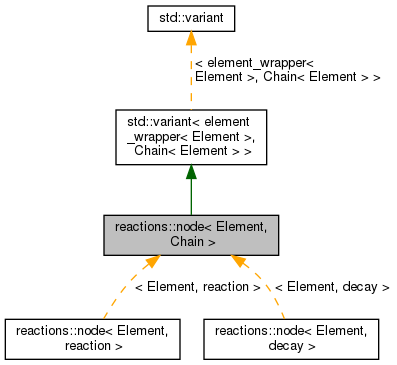
Inheritance diagram for reactions::node< Element, Chain >:
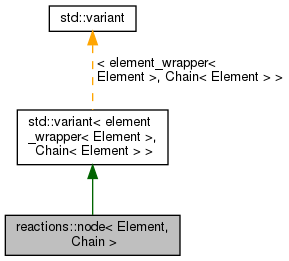
Collaboration diagram for reactions::node< Element, Chain >:
Public Types | |
| using | base_type = std::variant< element_wrapper< Element >, Chain< Element > > |
| using | element_type = element_wrapper< Element > |
| using | chain_type = Chain< Element > |
Public Member Functions | |
| bool | is_element () const |
| Check if the underlying class is an element. More... | |
| bool | is_reaction () const |
| Check if the underlying class is a reaction. More... | |
| bool | is_decay () const |
| Check if the underlying class is a decay. More... | |
| processes::node_type | type () const |
| Get the node type. More... | |
| Element const & | as_element () const |
| Return the pointer to the underlying object casted to an element. More... | |
| chain_type const & | as_chain () const |
| Return the pointer to the underlying object casted to a reaction. More... | |
Protected Member Functions | |
| element_type const & | as_element_wrapper () const |
| Return the underlying object casted to a wrapped. More... | |
 Protected Member Functions inherited from std::variant< element_wrapper< Element >, Chain< Element > > Protected Member Functions inherited from std::variant< element_wrapper< Element >, Chain< Element > > | |
| T | emplace (T... args) |
| T | index (T... args) |
| T | operator= (T... args) |
| T | swap (T... args) |
| T | valueless_by_exception (T... args) |
| T | variant (T... args) |
| T | ~variant (T... args) |
Detailed Description
template<class Element, template< class > class Chain>
class reactions::node< Element, Chain >
Base class for a process node.
This abstract class allows to check if the underlying class is an element or a chain object.
Member Typedef Documentation
◆ base_type
template<class Element, template< class > class Chain>
| using reactions::node< Element, Chain >::base_type = std::variant<element_wrapper<Element>, Chain<Element> > |
◆ chain_type
template<class Element, template< class > class Chain>
| using reactions::node< Element, Chain >::chain_type = Chain<Element> |
◆ element_type
template<class Element, template< class > class Chain>
| using reactions::node< Element, Chain >::element_type = element_wrapper<Element> |
Member Function Documentation
◆ as_chain()
template<class Element, template< class > class Chain>
|
inline |
Return the pointer to the underlying object casted to a reaction.
◆ as_element()
template<class Element, template< class > class Chain>
|
inline |
Return the pointer to the underlying object casted to an element.
◆ as_element_wrapper()
template<class Element, template< class > class Chain>
|
inlineprotected |
Return the underlying object casted to a wrapped.
◆ is_decay()
template<class Element, template< class > class Chain>
|
inline |
Check if the underlying class is a decay.
◆ is_element()
template<class Element, template< class > class Chain>
|
inline |
Check if the underlying class is an element.
◆ is_reaction()
template<class Element, template< class > class Chain>
|
inline |
Check if the underlying class is a reaction.
◆ type()
template<class Element, template< class > class Chain>
|
inline |
Get the node type.
The documentation for this class was generated from the following file:
- /home/docs/checkouts/readthedocs.org/user_builds/reactions/checkouts/stable/include/reactions/processes.hpp