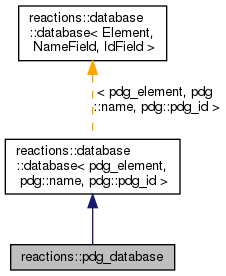
Database of elements following the PDG convention. More...

Public Types | |
| using | base_type = reactions::database::database< pdg_element, pdg::name, pdg::pdg_id > |
 Public Types inherited from reactions::database::database< pdg_element, pdg::name, pdg::pdg_id > Public Types inherited from reactions::database::database< pdg_element, pdg::name, pdg::pdg_id > | |
| using | element_type = pdg_element |
Public Member Functions | |
| pdg_element | charge_conjugate (pdg_element const &el) const |
| Return the charge-conjugate of an element. More... | |
| template<class... Args> | |
| void | register_element (Args &&... args) |
| Register a new PDG element. More... | |
| pdg_element | operator() (int id) const override |
| Create an element accessing by ID. More... | |
| pdg_element | operator() (std::string const &str) const override |
| Create an element accessing by name. More... | |
| Public Member Functions inherited from reactions::database::database< pdg_element, pdg::name, pdg::pdg_id > | |
| virtual | ~database () |
| std::vector< element_type > | all_elements () const |
| All the elements in the database file. More... | |
| void | clear_cache () |
| Clear the cache, removing also user-registered elements. More... | |
| void | disable_cache () |
| Disable the cache. More... | |
| void | enable_cache () |
| std::string const & | get_database_path () const |
| Get the path to the database file. More... | |
| void | register_element (Args &&... args) |
| Register a new element. More... | |
| void | set_database_path (std::string const &s) |
Static Public Member Functions | |
| static pdg_database & | instance () |
| Get the only instance of this class. More... | |
Additional Inherited Members | |
| Protected Member Functions inherited from reactions::database::database< pdg_element, pdg::name, pdg::pdg_id > | |
| std::ifstream | open_database () const |
| Open the database. More... | |
| std::streampos | skip_commented_lines (std::ifstream &file) const |
| Skip lines with comments (preceeded by *) More... | |
| bool | read_field (typename element_type::base_type &tuple, std::string const &line) const |
| Read a field with the given index from a line. More... | |
| bool | read_line (typename element_type::base_type &tuple, std::string const &line, std::index_sequence< I... >) const |
| Read all the fields from a line. More... | |
| bool | read_line (typename element_type::base_type &tuple, std::string const &line) const |
| Read all the fields from a line. More... | |
| element_type | read_element (std::string const &line) const |
| Advance to the next element in the file and read it. More... | |
| element_type | access (T const &v) const |
| Access an element using the field accessor. More... | |
| database (std::string &&db) | |
| database (database &&)=delete | |
| database (database const &)=delete | |
| void | operator= (database &&)=delete |
| void | operator= (database const &)=delete |
| Protected Attributes inherited from reactions::database::database< pdg_element, pdg::name, pdg::pdg_id > | |
| std::string | m_db |
| Path to the database file. More... | |
| class reactions::database::database::cache | m_cache |
Detailed Description
Database of elements following the PDG convention.
Member Typedef Documentation
◆ base_type
| using reactions::pdg_database::base_type = reactions::database::database<pdg_element, pdg::name, pdg::pdg_id> |
Member Function Documentation
◆ charge_conjugate()
|
inline |
Return the charge-conjugate of an element.
◆ instance()
|
inlinestatic |
Get the only instance of this class.
◆ operator()() [1/2]
|
inlineoverridevirtual |
Create an element accessing by ID.
Implements reactions::database::database< pdg_element, pdg::name, pdg::pdg_id >.
◆ operator()() [2/2]
|
inlineoverridevirtual |
Create an element accessing by name.
Implements reactions::database::database< pdg_element, pdg::name, pdg::pdg_id >.
◆ register_element()
|
inline |
Register a new PDG element.
The new element must have a name and a PDG ID that does not clash with any of the database used.
For the LaTeX name to be valid (an to avoid possible exceptions thrown during its computation), the element name must follow the following convention:
- The name starts with a set of characters. A capital letter followed by lowercase letters or a set of lowercase letters are considered as a Greek letter.
- The base name can be followed by a set of modifiers indicating the flavour, mass eigenstate or spin of the particle, between parenthesis.
- After, it is possible to indicate that the particle has a sligh variation with respect to another existing particle or that it corresponds to an excited state, in which it should be indicated with one or various prime symbols for the first case, or an asterisk for the second.
- The mass can be indicated between two parentheses as an integral number.
- The last part of the name is composed by the possible anti-particle marker, specified with a tilde, and the charge, which can be 0, + or -.
There is no official naming scheme for the PDG particles, but the following guidelines can be used in order to get the most common way of naming the particles:
- Quarks are specified with a single character, and anti-quarks extend this name by adding a tilde.
- If the name refers to a gauge boson, it must only contain the charge if it is named with a captial letter.
- Hadrons only contain the charge if there are other entries in the database with the same name. In the case of mesons, they also contain the charge if the particle is not self charge-conjugate.
- Particle names referring to mass-eigenstates contain the charge if the corresponding flavour eigenstates do.
- The anti-particles of mesons where the charge is in the name are specified using the opposite charge. For the rest, anti-particles are specified by including a tilde before the charge or at the end of the name, where adecuate.
The documentation for this class was generated from the following file:
- /home/docs/checkouts/readthedocs.org/user_builds/reactions/checkouts/v0.1.1/include/reactions/pdg.hpp.in